
Full disclosure: Yuki Takahashi is now the CEO of Pensight. This is his story as an English coach, before that.
"I was scared to say $35"
For two and a half years, Yuki taught at an English coaching school. The school found the students and set the prices. He was doing well, but he could already see the path ahead. Another year looked the same. Five more years looked the same.
In 2014, at 28, he went independent. Then came the moment every independent tutor knows: telling his own client his own price.
"Saying 'It's $35' felt huge," he says. "Would they think it was too expensive? Would they say no? I prepared for that conversation again and again."
If pricing still feels scary to you, that's the first thing he wants you to hear: he was there too. Being afraid to say your price isn't a sign you're not ready. It's a normal part of stepping forward.
Climbing the ladder, one step at a time
From there, he raised his price one step at a time: $35, $50, $75, $100. Each step came from doing the work. He got better at the service. More clients came through referrals. He studied people charging more than he did, and tried their services when he could. When he believed he could deliver the same value or more, he tested a higher price.
Then, around $100, he hit a ceiling. His schedule filled with people willing to pay that amount, and it stopped there.
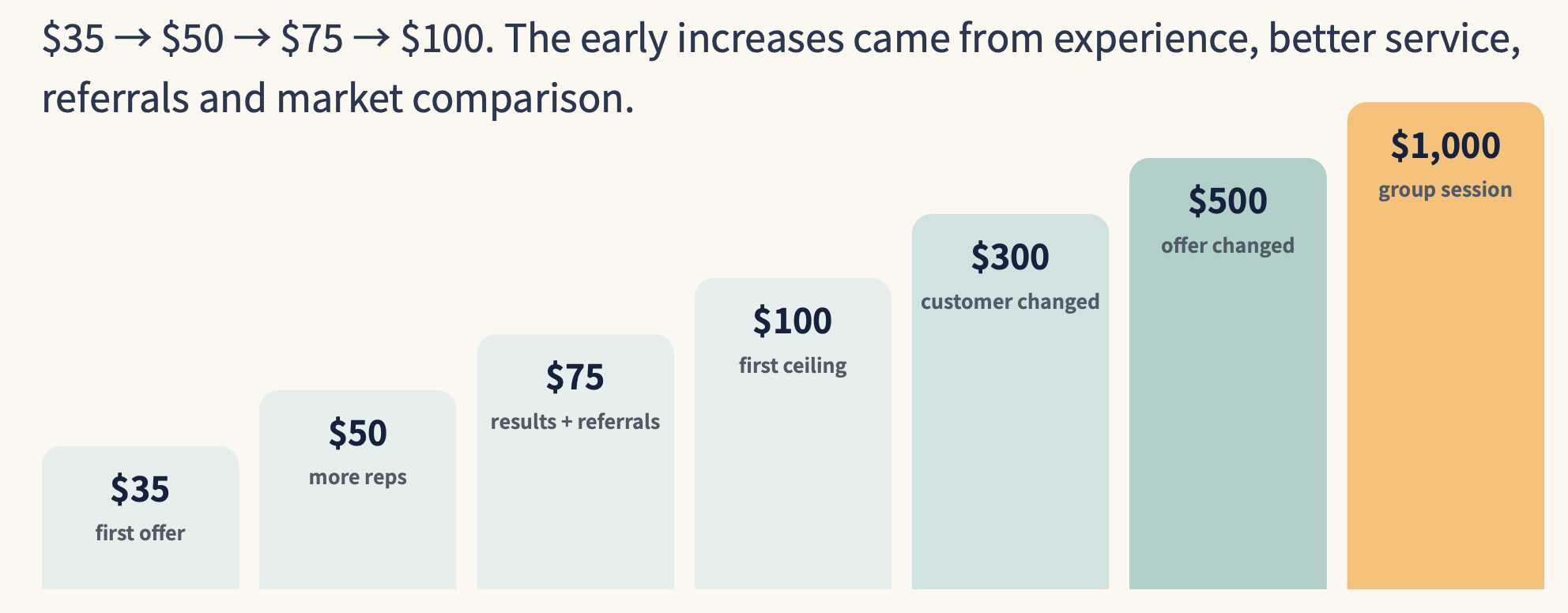
The move to $300 and $500 wasn't gradual. And it didn't happen because he suddenly got better at asking for money.
"The customer changed," he says.
When the customer changed
At 29, a former client introduced him to the owner of a large company that was expanding globally. The owner's problem wasn't simply "I want better English." If he could communicate in English the way he could in Japanese, it could change the company's global expansion. That was worth far more to the business than any lesson fee.
They agreed on a one-year private coaching arrangement at $7,000 a month. Yuki coached him in the car on the way to the office. He traveled to his home in Hawaii and coached him on the golf course. They recorded real conversations and turned them into personalized vocabulary, grammar and study materials.

"Serving him forced me to improve," Yuki says. "The old version of my service wasn't enough." And the question he asked about pricing changed too. Not "How much can I charge?" but "Why does this person see value at this price? And who else has a similar problem?"
"You decide whether to offer the price. The client keeps 100% of the right to say yes or no."
Two things that surprised him
1. The jump wasn't about the number. It was about the order of the conversation.
"The moment you say '$45 for 60 minutes,' the client starts doing math," he says. "Two sessions is $90, four is $180. The conversation becomes, 'Is one hour worth $45?'" So he changed the order of the conversation, and moved the price to the very end.
2. "$1,000 per session" wasn't one person paying $1,000.
The real setup was simpler than it sounds, and far easier to repeat than waiting for one exceptional client.
Free guide: What Is Your Hour Really Worth?
Yuki's 10-page guide, with a printable worksheet, covers:
- The order of the conversation he used before naming any price
- What "$1,000 per session" really looked like
- How to break apart a "no," and the four things you can change
- How to reverse-engineer the business you actually want
- Five questions for your next pricing experiment
Higher isn't always better
Yuki also pushed his pricing too far. When a client paid a high price but didn't fully engage or get results, he felt guilty taking the money. So he adjusted back to a level where both he and the client felt comfortable, with the right kind of positive tension.
"One person buying at an extremely high price isn't automatically better than 10 or 100 people buying at another price," he says. "Repeatability matters."
A "no" is data
For tutors who are scared of hearing no, he offers a different way to see it. "You decide whether to offer the price. The client keeps 100% of the right to say yes or no. Pricing is an experiment."
And often, a no isn't even about the price. The future may still feel vague to them. They may not yet believe you can help them get there. Or they may simply not be the right client.
The one regret
After coaching roughly 1,500 people, Yuki has one major regret: he didn't document enough. Thousands of hours of coaching disappeared. He didn't turn client outcomes into case studies, or lessons into content.
"Those experiences were assets I could have used again and again," he says.
Today, he's no longer coaching English. He's the CEO of Pensight, helping teachers, tutors and coaches shape and grow their businesses online.