

italki Commission 2026: How Much Teachers Actually Keep
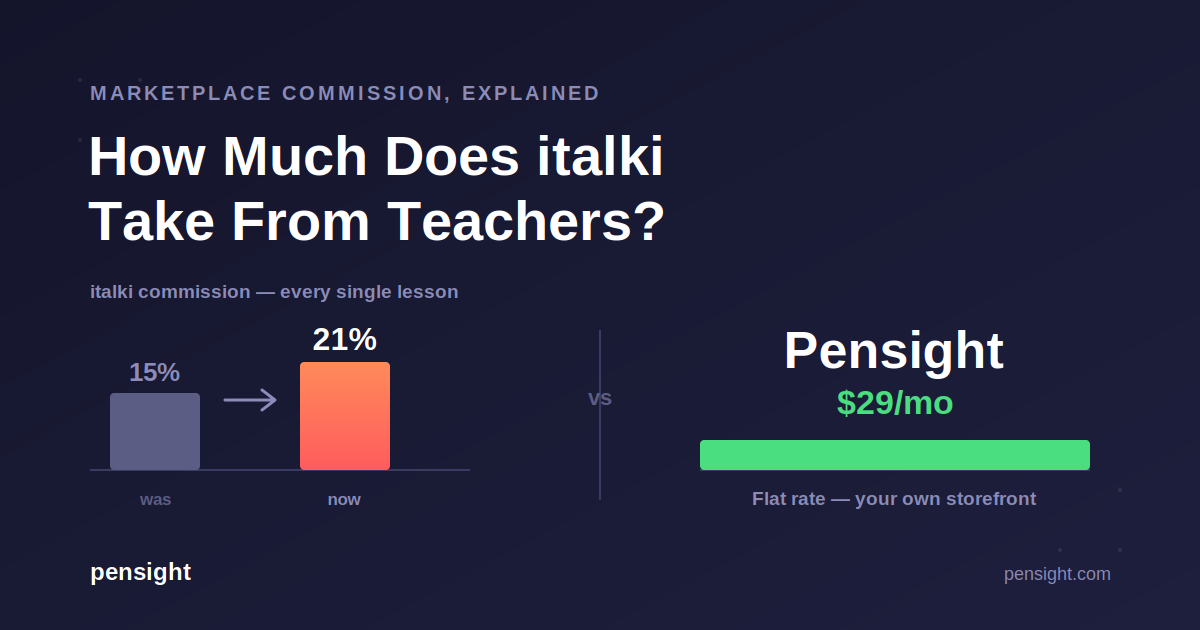
For years, italki was the low-commission option. Teachers who balked at Preply's 33% entry rate pointed to italki's flat 15% as proof that a marketplace could take a reasonable cut and still run a business. That reputation is now out of date.
Key takeaways
- italki has reportedly raised its commission on single one-to-one lessons from 15% to around 21%, with lower rates on prepaid packages and roughly 30% on group lessons.
- There are no tiers to climb — unlike Preply, your rate never improves with experience.
- Even at 21%, italki is cheaper than Preply's entry tier. But a lower commission doesn't remove the ceiling every marketplace shares: you can only ever sell your time.
- The language coaches earning $5,000–$10,000 a month add courses, group programs and memberships on a platform they own, such as Pensight, at $29/month flat.
What italki's commission looks like in 2026
italki's model is simpler than Preply's: there are no hour-based tiers to climb. Your rate is your rate. Here's what you keep on a $30 lesson:
- Single 1:1 lesson — around 21% commission. You keep $23.70.
- Prepaid lesson package — lower than 21%, varying by package size.
- Group lesson — around 30% commission. You keep $21.00.
italki has also signalled a partial rebate — reportedly up to 2% back for teachers who retain students and avoid cancellations. Whether that's achievable in practice is still an open question among teachers.
An important accuracy note: the 21% figure comes from teacher-community reporting rather than a directly verifiable public policy page. Older published sources — including several TEFL training providers — still cite 15%. Confirm the current rate on italki's own instructor terms page before making any decisions based on this article.
italki vs Preply: the honest comparison
For a teacher's first year, italki is usually the better financial deal. A teacher charging $25 per lesson keeps about $19.75 on italki. The same teacher on Preply's entry tier keeps roughly $16.75 — and hands over the entire first lesson with every new student for free.
Preply's sliding scale eventually drops to 18%, below italki's single-lesson rate. But reaching that floor takes 400+ teaching hours, roughly five months of near-full-time work. Most teachers never get there, and the ones who do have already paid thousands in commission along the way.
The structural differences, side by side:
- Commission structure — italki: flat, around 21% on single lessons. Preply: sliding, 33% down to 18%.
- Improves with experience — italki: no. Preply: yes, but slowly.
- Trial lesson cost to the teacher — italki: discounted, not free. Preply: 100% goes to the platform.
- Better suited to — italki: new and mid-stage teachers. Preply: high-volume veterans.
Full breakdown of Preply's commission tiers →
How italki compares to the rest of the market
- Verbling takes a flat 15% — currently the lowest rate of the major language marketplaces, with no trial-lesson clawback. Why the lowest cut still has a ceiling →
- Preply starts at 33% and takes the full fee on every trial lesson, but drops to 18% at high volume. Preply's commission, explained →
- カフェトーク (Cafetalk), the largest Japanese-market platform, starts teachers at a 40% margin. カフェトークの手数料の詳細 →
Why the rate isn't really the problem
Here's the thing about arguing over 15% versus 21%: it distracts from the number that actually caps your income.
On any marketplace — italki, Preply, Verbling, all of them — you earn hours multiplied by rate. That's it. There is no version of italki where you sell a self-paced course, run a six-week group cohort, open a paid community, or email the students you've taught for two years about a new offer. The platform owns the relationship, and the product catalogue is one item long: your time.
A commission increase is annoying. A structural ceiling is what keeps teachers at $2,000 a month for years.
What the teachers who broke through actually did
The pattern is consistent: they stopped treating the marketplace as their business and started treating it as one channel within it.
Stage one is marketplace-only — every dollar tied to an hour taught, income capped by your calendar. Stage two is marketplace plus owned products: still teaching on italki for steady student flow, while building a course, group program, or membership somewhere you control. Stage three is owned-first, where the marketplace becomes optional.
You don't have to leave italki to reach stage two. You need somewhere to put the parts of your business a marketplace was never built to hold.
Marketplace vs. your own platform
What italki gives you, and what it can't:
- Finds students for you — italki: yes, that's the core value. Your own storefront: no, you bring your own audience.
- Ongoing cost — italki: around 21% of every lesson, forever. Your own storefront: $29/month flat, plus a ~3% Stripe payment-processing fee on transactions.
- Who owns the student relationship — italki: the platform. Your own storefront: you.
- Selling courses — italki: not possible. Your own storefront: yes.
- Group programs and memberships — italki: not possible. Your own storefront: yes.
- Emailing your students directly — italki: not possible. Your own storefront: yes.
- Income model — italki: hours × rate, capped by your calendar. Your own storefront: products and programs, uncapped.
Build your own platform on Pensight
FAQ
How much commission does italki take from teachers?
italki reportedly takes around 21% on single one-to-one lessons as of mid-2026, up from a long-standing 15%. Lesson packages carry a lower rate and group lessons around 30%. Confirm current figures on italki's instructor terms page.
Did italki raise its commission?
Teacher-community reporting indicates a rise from 15% to 21% on single lessons, alongside a possible 2% rebate tied to student retention. Several published guides still cite the older 15% figure.
Is italki cheaper than Preply for teachers?
For most teachers, yes — particularly in the first year. Preply's rate only drops below italki's after 400+ hours taught.
Which language marketplace takes the smallest cut?
Verbling, at a flat 15%, followed by italki at a reported 21% on single lessons.
Can I sell courses on italki?
No. italki is built around live lesson bookings. Courses, memberships, and email marketing require a separate platform.
Is it against italki's rules to have my own website?
No. Running your own teaching business alongside your profile is fine. The line is taking students italki introduced you to off-platform to avoid commission on lessons you owe them for. Products you sell to your own audience are a separate business.
How do I offset a commission increase?
The direct route is raising your lesson rate by roughly 7–8%. The durable route is building a revenue layer commission doesn't touch.
Start building the layer a marketplace can't hold: Claim your free Pensight store →
A note on accuracy: commission rates are set by each marketplace and change without much notice. The figures above reflect widely reported community sourcing as of mid-2026 and could not be verified against italki's official policy page at the time of writing. Confirm current rates directly with italki before making financial decisions.


