

Verbling's 15% Commission: The Lowest Rate Still Has a Ceiling
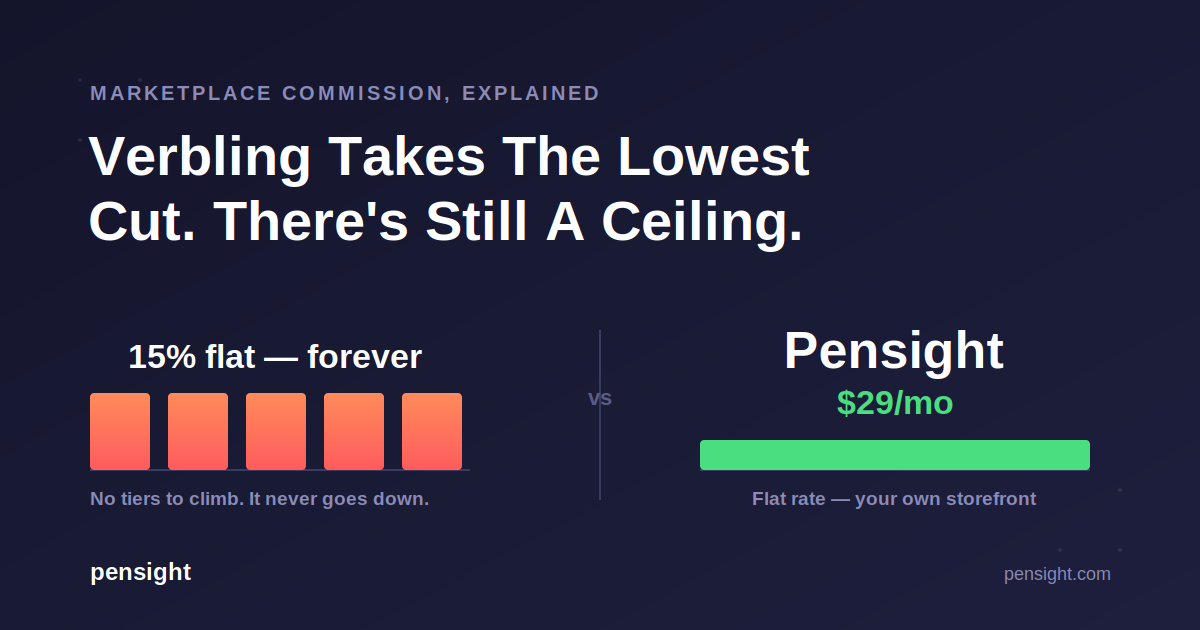
Verbling is the easiest platform on this list to defend. The commission is flat, it's published openly, and at 15% it's the lowest rate among the major language marketplaces. There's no tier ladder to climb, no clawback on your first lesson with a new student, no surprise in month three.
Key takeaways
- Verbling applies a flat 15% commission — set your hourly rate at $20 and you receive $17. It's the most teacher-friendly rate in the category.
- There are no tiers and no trial-lesson clawback. The rate is the same on your first lesson and your thousandth.
- Even so, at $30/hour and 20 lessons a week you top out around $2,200 a month. The commission isn't what caps you — your calendar is.
- The language coaches earning $5,000–$10,000 a month add a second revenue layer that isn't billed by the hour, on a platform they own, such as Pensight, at $29/month flat.
How Verbling's commission works
Verbling's own support documentation states it plainly: teachers set their own hourly rates and always keep 85% of whatever they charge, with 15% going to Verbling. You can change your rates at any time, and earnings can be cashed out weekly.
What that looks like at common rates:
- $15/hour — Verbling takes $2.25. You keep $12.75.
- $20/hour — Verbling takes $3.00. You keep $17.00.
- $30/hour — Verbling takes $4.50. You keep $25.50.
- $50/hour — Verbling takes $7.50. You keep $42.50.
Most Verbling teachers charge somewhere between $14 and $30 per hour, though the range on the platform runs from under $10 to around $100.
Credit where it's due: this is a genuinely fair structure. No trial-lesson clawback, no penalty for being new, no five-month climb to a decent rate. If you're going to teach on a marketplace, Verbling's terms are among the best available.
How it compares to the other language marketplaces
- Commission — Verbling: 15% flat. italki: around 21% on single lessons. Preply: 33% sliding down to 18%.
- Trial lessons — Verbling: no 100% clawback. italki: discounted. Preply: the full fee goes to the platform.
- Rate improves over time — Verbling: no, because you start at the floor. italki: no. Preply: yes, after 400+ hours.
- Selectivity — Verbling: high. italki and Preply: open.
Full breakdowns of the others: Preply's commission tiers → · italki's rise from 15% to 21% → · カフェトークの手数料 →
Verbling is also more selective than its competitors, which cuts both ways: less competition from unqualified teachers, but a harder door to get through, and applications have been intermittently limited. The platform was acquired by Busuu in 2020 and has focused on adult learners since.
So why do Verbling teachers still hit a wall?
Run the math forward. At $30 an hour with a 15% commission, you keep $25.50 per lesson. Teaching 20 lessons a week — a serious, sustainable load — that's about $2,200 a month.
To double it, you teach 40 lessons a week. To double it again, you'd need 80, which doesn't exist. The commission isn't what's capping you. Your calendar is.
This is the part that gets lost in commission comparisons. Even at 0% commission, a pure marketplace model caps your income at hours multiplied by rate. Verbling has no mechanism for selling a self-paced course, running a group cohort, hosting a paid community, or emailing the students you've taught for three years. One product, priced by the hour, sold one seat at a time.
[Placeholder: insert stat from Pensight's "Anatomy of a $10K Language Coach" report — the revenue split between marketplace teaching and owned products among top-earning coaches.]
The dual-track model
The teachers earning $5,000–$10,000 a month didn't find a marketplace with better terms. They added a second revenue layer that isn't priced by the hour.
Stage one is marketplace-only: steady, capped, entirely dependent on the platform's student flow. Stage two keeps the marketplace for what it's genuinely good at — finding students — while a course, group program, or membership runs somewhere you control. Stage three is owned-first, where the marketplace becomes an optional top-of-funnel channel.
Verbling's low commission actually makes it a good stage-two partner. You're not bleeding money staying on it. You're just not growing on it either.
[Placeholder: insert 2–3 paragraph coach story with real numbers.]
Marketplace vs. your own platform
What Verbling gives you, and what it can't:
- Finds students for you — Verbling: yes, that's the core value. Your own storefront: no, you bring your own audience.
- Ongoing cost — Verbling: 15% of every lesson, forever. Your own storefront: $29/month flat, plus a ~3% Stripe payment-processing fee on transactions.
- Who owns the student relationship — Verbling: the platform. Your own storefront: you.
- Selling courses — Verbling: not possible. Your own storefront: yes.
- Group programs and memberships — Verbling: not possible. Your own storefront: yes.
- Emailing your students directly — Verbling: not possible. Your own storefront: yes.
- Income model — Verbling: hours × rate, capped by your calendar. Your own storefront: products and programs, uncapped.
Build your own platform on Pensight
FAQ
How much commission does Verbling take?
A flat 15% on all completed lessons. Set your rate at $20 and you receive $17.
Does Verbling's commission go down with experience?
No. There are no tiers — 15% applies from your first lesson to your thousandth. Unlike Preply, there's nothing to climb toward, because you start at the floor.
Is Verbling cheaper for teachers than italki or Preply?
Yes, on commission alone. Verbling's 15% flat rate is lower than italki's reported ~21% on single lessons and well below Preply's 33% entry tier.
Which language marketplace takes the smallest cut?
Verbling, at a flat 15%. italki follows at a reported 21% on single lessons, and Preply is highest at entry with 33%.
Can I sell courses or group programs on Verbling?
No. Verbling is built around live 1:1 lesson bookings. Courses, memberships, and email marketing require a separate platform.
Is it against Verbling's rules to have my own storefront?
No. Running your own teaching business alongside your profile is fine. The line is taking students Verbling introduced you to off-platform to avoid commission. Products sold to your own audience are a separate business.
How much can a Verbling teacher realistically earn?
At $30/hour and 20 lessons a week, roughly $2,200 a month after commission. Scaling past that means either raising rates or adding income that isn't billed by the hour.
Or start building the layer a marketplace can't hold: Claim your free Pensight store →
A note on accuracy: commission rates are set by each marketplace and can change. Verbling's 15% rate reflects its published teacher support documentation as of mid-2026. Confirm current terms directly with Verbling before making financial decisions.


